Short answer: Finance and Sales usually report different gross margins because they calculate it from different inputs: posted invoices or open orders, standard or actual cost, and different treatment of discounts, freight and returns. The fix is one approved definition, owned by Finance, applied the same way in every report.
What is gross margin in Dynamics 365 reporting?
Gross margin is revenue minus cost of goods sold, divided by revenue. A customer with $1.84M revenue and $1.50M cost of goods sold earns $342K gross profit, a gross margin of 18.6%.
The formula is simple. The disagreement sits in the inputs: which revenue counts, which cost applies and which period a transaction belongs to. Dynamics 365 holds all of these, and each can be read more than one way.
This article is part of our guide to AI reporting for Microsoft Dynamics 365, which explains how data areas keep AI-generated reports consistent.
Why do Finance and Sales get different figures?
Finance reports 14.2% gross margin for a customer. Sales reports 12.9%. Both figures come from the same Dynamics 365 data, so the difference comes from how each team calculated them.
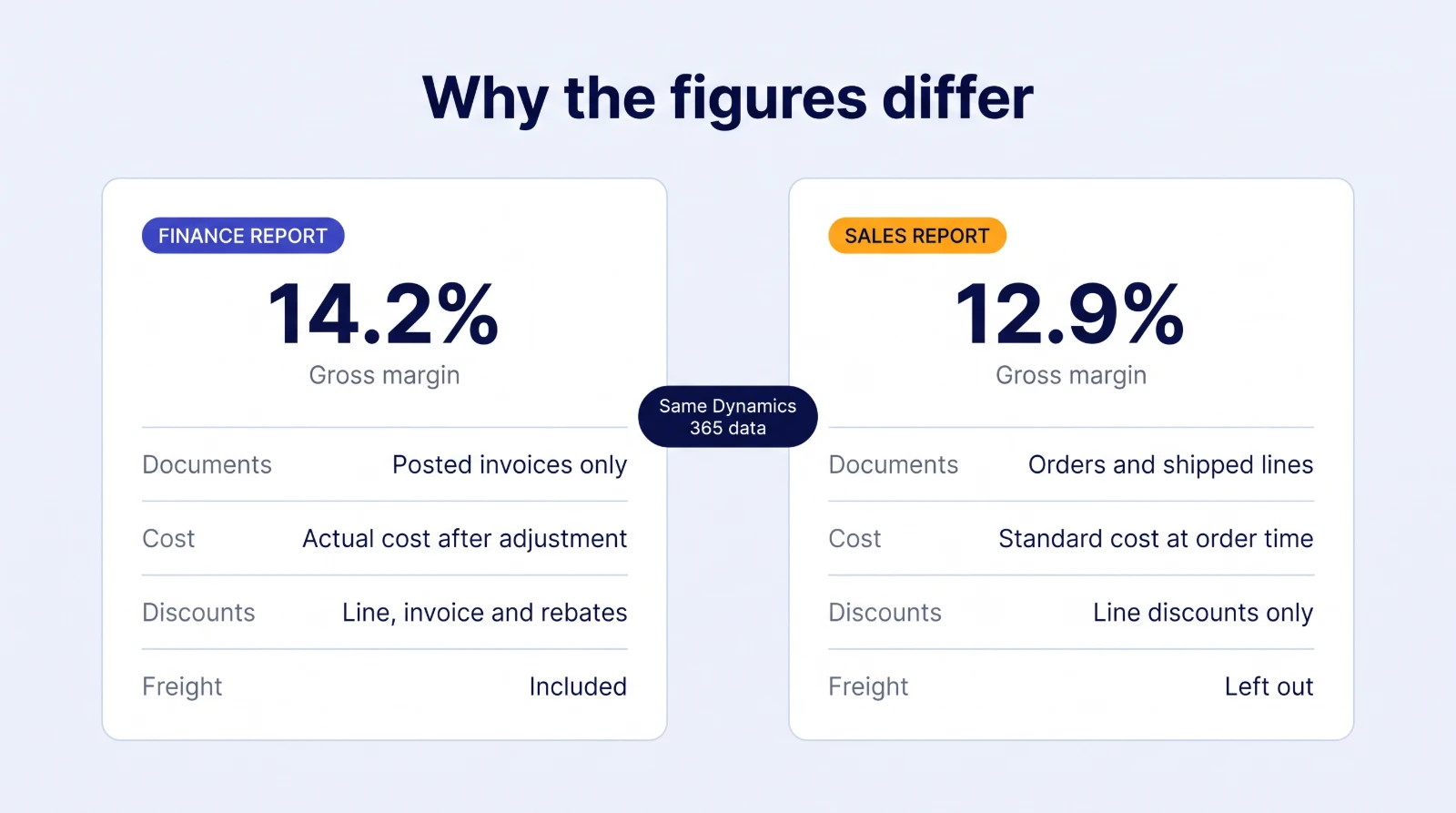
The gap almost always traces back to a handful of choices made when each report was built.
| Choice | Finance report, often | Sales report, often |
|---|---|---|
| Which documents count | Posted sales invoices only | Open orders and shipped, uninvoiced lines as well |
| Which cost applies | Actual cost after cost adjustment | Standard or estimated cost at order time |
| Discounts and rebates | Line and invoice discounts, plus rebate accruals | Line discounts only |
| Freight and charges | Freight revenue and freight cost included | Freight left out of both |
| Returns and credit memos | Netted against revenue in the period | Excluded or counted when the return ships |
| Period | Invoice posting date | Order or ship date |
| Currency | Reporting currency at the posting rate | Transaction currency or today’s rate |
None of these choices is wrong on its own. The problem starts when two reports make different choices and carry the same label.
What does an unresolved margin gap cost?
While the definitions differ, every margin review starts by reconciling the two figures.
- Pricing decisions stall. A customer below a 12% threshold in one report and above it in the other can’t be repriced with confidence.
- Analyst time goes into explaining numbers. The hours go into tracing two workbooks rather than into the customers that need attention.
- Trust in reporting drops. Once people see two margins for one customer, they question the next report as well.
How do you agree on one gross margin definition?
Agreeing on a definition is a short, structured exercise, and the steps are the same whatever reporting tool you use.
- Name the owner. Gross margin is a financial measure, so Finance owns it. Sales contributes requirements; Finance approves the wording.
- Decide each choice in the table above. Record a decision for documents, cost, discounts, freight, returns, period and currency.
- Write it in business terms. For example: “Revenue from posted sales invoices by posting date, net of line and invoice discounts and credit memos, less actual cost of goods sold, in reporting currency.”
- Test it against a closed period. Calculate margin for a closed quarter and reconcile the total with the posted income statement.
- Publish it with a version and date. Everyone reporting on margin uses the same text.
- Keep a change log. When the definition changes, for example to include rebate accruals, record the date and reason so old and new reports can be compared.
Depends on: current item costs. In Business Central, actual cost depends on the Adjust Cost – Item Entries batch job having run. In Supply Chain Management, it depends on inventory close and recalculation. A definition based on actual cost reports provisional margins until those processes complete.
Should a margin report use standard cost or actual cost?
Use actual cost for reporting on closed periods and standard cost only when the question is about a forecast or a quote. Actual cost reflects purchase price variances, landed costs and production variances that standard cost leaves out, so it is the figure that reconciles with the general ledger.
If Sales needs an early view before cost adjustment runs, label it as provisional rather than creating a second definition with the same name.
How does InsightsCTRL use the agreed gross margin definition?
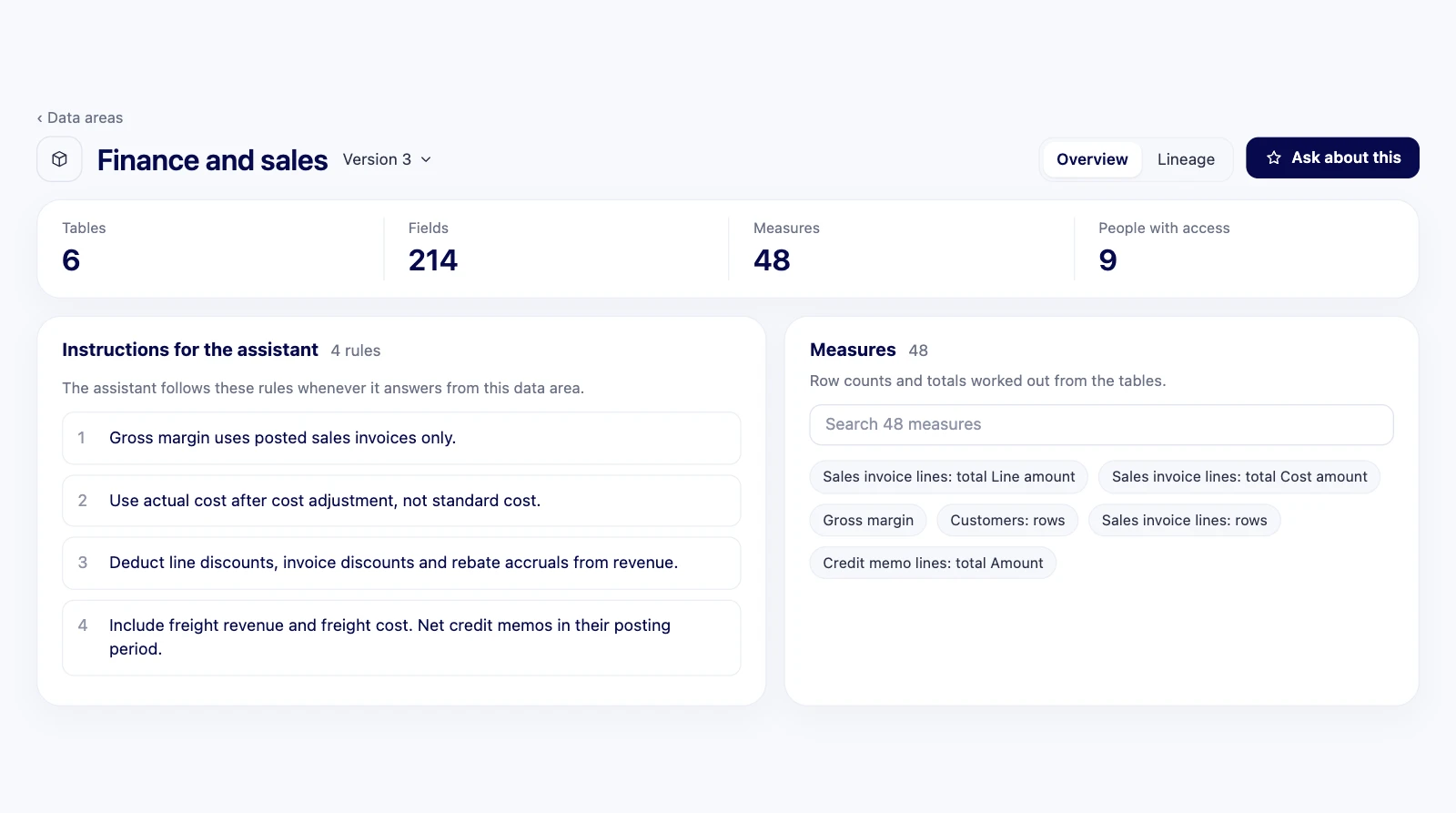
InsightsCTRL answers every question from a data area: the tables, measures and plain-language rules your team set up. Once Finance agrees the gross margin definition, an administrator adds it to the data area as a rule, for example “Gross margin uses posted sales invoices and actual cost after adjustment.” A sales manager asking “Which customers fell below 12% gross margin last quarter?” gets the same calculation a controller would.
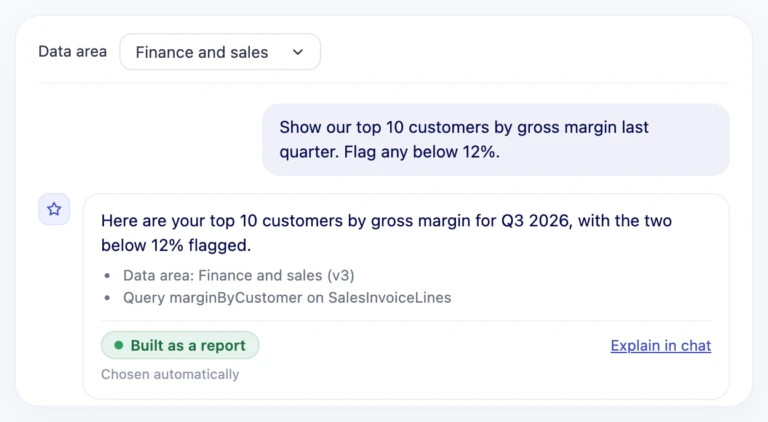
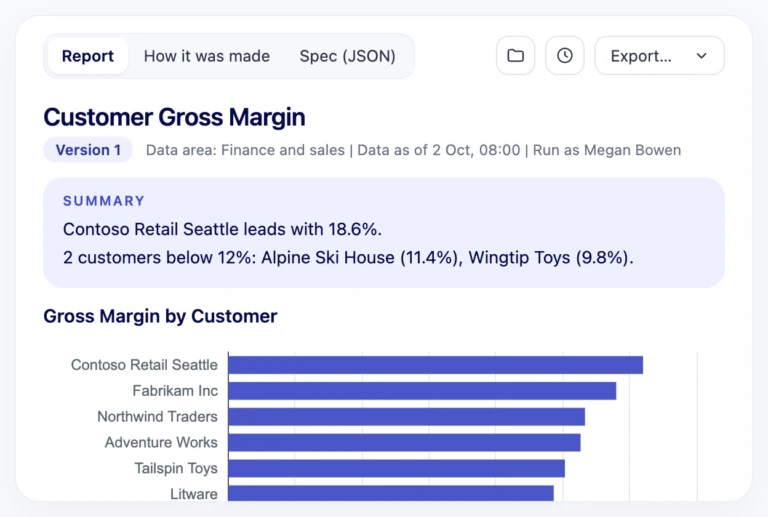
In the Contoso demo data, the question “Show our top 10 customers by gross margin last quarter. Flag any below 12%” returns $9.42M revenue at a 16.1% gross margin for Q3 2026. Alpine Ski House (11.4%) and Wingtip Toys (9.8%) are flagged. How it was made lists the data area, the tables read and the measures used, and the report header shows when the data was current, so anyone reading the report can see what produced it.

Try it with a follow-up. Ask for your top 10 customers by gross margin last quarter, then ask to group them by region. The regional view uses the same measure and the same 12% threshold.
Follow-up questions use the same data area and rules, and a scheduled report re-runs the saved report the same way every time. Checking how an AI-generated report was calculated shows what to review in How it was made.
What should Finance do first?
Pick the measure that causes the most debate, which for most companies is gross margin, and run the six steps above for that measure alone. Once that definition is agreed, the margin reviews that follow no longer start with a reconciliation.
Then extend the same exercise to the next contested measure. For the wider approach, read AI reporting for Microsoft Dynamics 365. To see your own margin question answered on demo data, book a demo.